January 09, 2012

Bring Back the Old-Timey Political Nickname

I've started in on The Game of Thrones of political biography, Robert Caro's The Years of Lyndon Johnson. The first volume, The Path to Power, begins by establishing the Texas political scene prior to LBJ's birth and during his childhood as the son of a Populist state representative.

As a savorer of political lore, I have to say that the modern era has lost one great element from the early part of the last century—the old-timey nickname. Honest Buck. Old Oxcart. Cactus Jack. Heck, I would settle for Pinky.

The trick is that the nicknames have to be favorable, bestowed by admirers. In the modern media environment unironic affection for political leaders is harder to find. Reagan had “the Gipper”, but he got it on loan from Hollywood. Margaret Thatcher's “the Iron Lady” cut both ways.

I'm too much the satirist to come up with straight-faced, old-timey-ish nicknames for current figures. Hillary “Pant Suit” Clinton? Michelle “Crazy Eye” Bachmann? Rick “Santorum” Santorum?

The best I can do is Barack “Long Game” Obama. Fans of the Steve's Dad candidate might go for Ron “Gold Standard” Paul.

What moniker would you bestow on the politician you admire?

January 05, 2012

Avoiding Foot-Mouth Proximity Incidents (Creator Interaction Edition)

Now that you've had time to check out the podcast episode mentioned in yesterday's post, it's time for me to lay a little Rashomon on Joe's account of an awkward Gen Con moment . To recap, Joe remembers me looking at him like he was a “total douchebag” because he hadn't yet wrapped his head around Hamlet's Hit Points. Co-host Nicky avers that this is because Joe was indeed being a total douchebag.

I wouldn't say it quite like that.

Joe led off with a faux pas, to be sure, and I, wag that I am, let him twist in the wind over it. To paraphrasing from memory, he started by saying that he didn't like HHP as well as Robin’s Laws of Good Gamemastering. I laughed at this, in an oh really kind of way, and then proceeded to tease him about this for the remainder of our chat. And am teasing him a bit more now, because that's how I roll. Another creator in similar circumstances might conceal his dudgeon, or get genuinely shirty with you.

Which brings me to a general service announcement. Here are a few handy tips on how to maintain mutually comfortable foot-mouth separation when talking to creators you meet at conventions, signings, and similar events.

The apparent intimacy of the Internet, and the opportunity it provides to express your judgments on art and entertainment products, may lead you astray when it comes time to engage in person people whose work you admire. You may think that creators want to hear critiques of their work expressed with the same frankness you'd use when talking with friends or posting to a forum.

They do not.

Even the necessary process of getting notes from collaborators and trusted readers can be emotionally fraught. Unsolicited notes during a casual social encounter? Etiquette breach! Etiquette breach!

That doesn't mean you ought to fawn, or claim that you like stuff that you don't. Remember though that the unwritten rules of casual interaction remain in force.

When in doubt, ask yourself if you'd expect a good reaction to a comment were the subject swapped to something more mundane.

“I don't like that shirt as well as the one you wore last week.”

Or, given that creative work is a labor of love riven with self-doubt and setback, test your remark by recasting it in a more deeply personal vein:

“I don't like that new baby of yours as well as your first kid.”

If you have an issue with the work, you might succeed in smoothly raising it, if you are indeed a master of diplomacy. Phrasing it in the form of a question might help. “I didn't believe it when Josie went back into the house,” comes off as a note, and is socially assaultive. “Why did Josie go back into the house?” expresses the same thought but doesn't play as a critique.

Roleplayers are luckier than fans of passively consumed work; they can describe practical problems they had in play, or anticipate having in play. “How do I make combat crunchier?” obeys the etiquette of casual interaction. “I still don't like your combat system,” violates it.

Some become unnecessarily anxious when meeting people whose work they like. No one in this field is a Clooney-level celebrity who needs social insulation from fans. I sure want people to feel comfortable approaching me for a chat. I strive to make myself accessible, and so do the vast majority of my colleagues.

On occasion this anxiety leads to a related faux pas, in which an embarrassed speaker tries to defuse the situation by backhanding the compliment, inadvertently converting it into a jab. Never feel you have to apologize, or undercut yourself, when saying something nice.

If a creator makes you feel bad for being excited about his work, they're the douchebag.

Not that Joe, in our inciting example, was being a douchebag, total or otherwise. He just had an unfortunate foot-mouth proximity incident (FMPI), which happens to all of us now and then.

And now we are all well-equipped to avoid similar FMPIs of our own.

January 04, 2012

2 GMs, 1 Mic On Hamlet's Hit Points

In episode 20 of their 2 GMs, I Mic podcast, the irrepressible Joe Wolz and Nicky Helmkamp tackle the issue of pacing in roleplaying games. In the process, they give Hamlet's Hit Points a thorough and gratifying examination. Those of you already familiar with the book may be most interested in the examples they give of applying its lessons to actual play.

Joe tells a funny story on himself in which, when talking to me at Gen Con, his comments on the book led me to look at him like he was a “total douchebag.” While it is true that he led with a wee faux pas, I would, and will, characterize the moment somewhat differently. But before I turn the anecdote into a remake of Rashomon set at the Pelgrane booth, I'll give you time to listen to the Wolz-Helmkamp version.

January 03, 2012

Shotguns v. Cthulhu Cover Preview

Here's a peek at the cover for Shotguns v. Cthulhu, the upcoming anthology of action-oriented Lovecraftian tales from Stone Skin Press. Jason Morningstar brilliantly captured the bold, graphic look we're pursuing for the line with his double-barreled, multi-tentacled retake of the skull and crossbones motif. Sans text, the design would look great on a T-shirt. Alas, that's a category of merchandise publishers have difficulty shifting, so you'll just have to keep an eye out for the book when it arrives later in 2012.

December 31, 2011

A New Year's Tale

Scene: a new preserves and charcuterie shop in Kensington Market, Toronto. In keeping with the place's friendly vibe, the counter guy tries to engage a customer in conversation. The customer, in his mid 50s, dressed in a natty overcoat, sits on a bench eating the sandwich he's just been served.

COUNTER GUY: Do you have any plans for New Year's?

CUSTOMER: [has a mouthful of sandwich, unable to talk.]

COUNTER GUY: Any special plans?

CUSTOMER: [indicates that he's eating and can't reply]

COUNTER GUY: Anything special you're doing for New Year's?

CUSTOMER: [rising] My wife wants to divorce me, because of my girlfriend.

December 23, 2011

Sleigh Bell Sign-Off

The presents are wrapped, the Christmas pudding cooked, and it’s time once again for my holiday sign-off. As visions of sugar plums dance in my head, I’d like to thank everyone for hanging out here, or dropping in from your redoubts at Twitter, Google+, and Facebook. I’ve been grateful for your attention as I launched Ashen Stars and The Worldwound Gambit. Hamlet's Hit Points, released in 2010, continues to find new readers, which pleases me to no end, proving that a labor of love can make good in our long tail world.

The big news here on the blog was my pre-Gen Con flight from Livejournal to Blogger. The latter’s better analytics and the immediate success of Google+, have helped me to keep the joint alive as eyeballs shift from blogs to social networks. Highlights of the year in blogging include the wrap-up of the Korad world-building experiment, a Kovalic-led encounter with a classic Wisconsin smelt fry and its requisite brandy old-fashioneds, a two-pronged assault on creative paralysis, and a Cthulhoid victory in the annual Gen Con buzzword competition, and the traditional TIFF Capsule Reviews. Together we hated on haters, reconsidered secrecy, and feared the rising of the dread mascots.

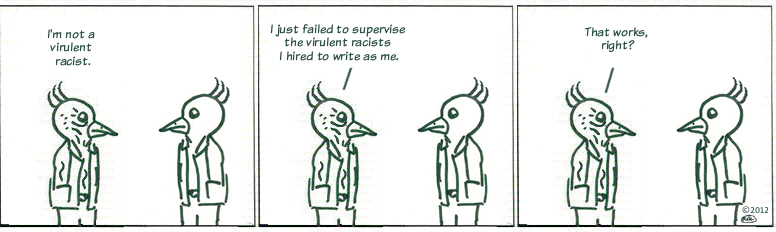
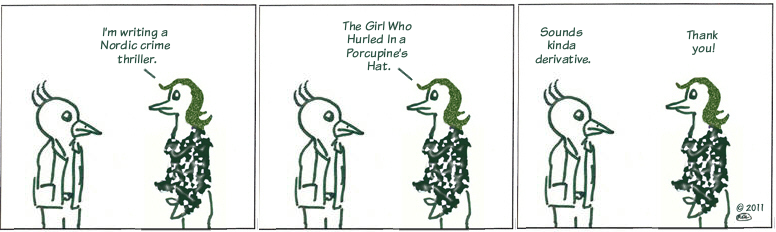
I’ll be back in the new year to keep you updated on Hillfolk and The Gaean Reach, to share the scoop on new fiction projects, and to kick off the impending “Ken and Robin Talk About Stuff” podcast. With a US election cycle fully swinging, I may dare to disturb the dusty padlock on the Politics Hut. How To Design RPGs the Robin Laws Way will resume, as will the usual talk about movies, narrative, writing and the gun-toting despond of deadpan avians.

Until then, enjoy or survive, as the case may be, your holiday time with friends and family. Imbibe judiciously and beware of road hazards, whether they consist of black ice, drunk guys, or Heat Misers.

Merry Christmas, Internet!

December 22, 2011

See P. XX

Down the non-Euclidean chimney comes Santa Cthulhu with a big bag of year-end See P. XX. Find the sneak peek at the Shotguns v. Cthulhu cover amid sundry other gifts from Pelgrane Press:

  • My column on information flow in GUMSHOE.

  • The horoscope of the mysteriously dead Augustus Darcy, occultist author famed for The Book of Smoke.

  • The conspyramid contest for Night’s Black Agents.

  • Winners and answers for the Cthulhu Apocalypse contest.

  • New releases and a peek at Pelgrane’s 2012 slate.

All gather round the eldritch fireplace!

December 21, 2011

Ironic Hero, Absurdist Villain

If an iconic hero remains true to himself and thereby changes the world around him, the ironic hero hews to his inner compass and is disappointed by the way the world changes despite him. We don’t see the ironic hero much in fiction, because that pattern is too much like life.

As is apt for a playwright, the life of Vaclav Havel divides readily into three acts—from avant garde dramatist to dissident to head of state. In that third act, he becomes an ironic hero. The act begins with heady early days, scored to deep Zappa cuts, as he strives to infuse his office with an artist’s humanism. From these scenes of bohemian promise, the story shifts tones. He presides as a constitutionally weak President over a society quickly bored by his ideals. Despite his efforts, his country splits in two. He urges the dismantlement of the lucrative Czech arms industry, and is rebuffed. Havel remains a hero to the outside world, and certainly to me. To the home audience, not so much. Heroes get tiresome when they stick around too long. We prefer them when they to ride off into sunset in timely fashion.

The ironic hero is sadder than the tragic hero, and leaves the stage without catharsis. The tragic hero falls from greatness, brought low by his telling flaws. The ironic hero fades, due to ours.

In a bid to provide easy contrast for blog posts, Kim Jong Il died on the same day as Havel. By immiserating an entire nation and killing millions by famine in order to maintain his cult of personality, he leaves a legacy as one of the era’s most monstrous real-life villains. The scale of his crimes makes him almost too monstrous for fiction. Another of his qualities definitely disqualifies him as a fictional bad guy—despite his enormous body count, he was as ridiculous as he was menacing. This is a consistent trope of the modern mega-mass-murdering dictator. Comic characters become funny through a gap between self-perception and the way others see them. Mussolini, Gaddafi, and Saddam Hussein all embodied not just the banality but the absurdity of evil. It’s not always the case—Pol Pot managed to be straight-up sinister, and the publicity-shy goons running Burma are no barrel of yuks. Kim, however, might have been a character in one of Havel’s allegorical plays.

December 20, 2011

A Contrary Life

A motif emerges in friends’ reminiscences of the alternately brilliant and maddening Christopher Hitchens. At some point they all have to note that they didn’t agree with Hitchens on everything. In fact his barbed-wire views were so various, so untethered from standard ideological allegiances, that it is mathematically impossible to agree with all of them.

Many of the tributes mull the question of whether Hitchens was, in the end, a man of the left or right. If you go by the degree of discomfort eulogists of both factions display toward him, he winds up on the left. His liberal friends may have a tough time accepting his unrepentant touting of the Iraq conflict, but that pales compared to conservative distaste for his atheism and general loathing for hierarchy. Lots of young Trotskyites wound up as neoconservatives. Hitchens didn't so much discard one for the other as fuse the impulses together, with ferocity of judgment the bonding agent.

Admiring individual contrarians, as opposed to contrarianism itself, can be a fraught business. When summoning a pithy Mencken quote one has to keep in mind his pro-German sentiments in the lead-up to WWII. In late career, the contrarian may reveal himself not as an all-around puncturer of fuzzy thinking, but a much less interesting creature, the hedonistic Tory.

Still, one can look to figures like Hitchens and Mencken for the aspiration to question assumed truths, and to pursue logical propositions to their pitiless conclusions. To defend itself, even a culture of empathy needs the ability to construct an argument. Relying on cant or empty pieties leaves you only able to sputter when challenged. What does not kill your argument makes it stronger.

No matter how intense a detractor one might be of one Hitchens stance or another, the techniques he uses are transferable to the support of any position based on facts and reason.

If you look at him as a practitioner of the vanishing art of debate, his weak arguments become as informative as his strong ones. There you see the dodges you might skewer when deployed against you. In neocon mode, Hitchens cheats wildly, engaging his opponents’ worst arguments or resorting to untestable counterfactual assertions. This is where you see his twin passions, his hatred of tyranny and religion, combining to overwhelm the skepticism that anchors his best polemical writing.

I certainly envy the legendary Hitchens recall—virtually everything he read went straight to the memory bank and stayed there. As someone who makes his living as a writer, I can only gasp at his mammoth output, mysteriously squeezed into days given over to the voracious pursuit of Johnny Walker-fueled conversation. One account clocks him at a hard-to-credit 10,000 words per day—all the more staggering when you consider time spent on reading and other research.

With his prodigious intake of Scotch and cigarette smoke, Christopher Hitchens embodied the romantic image of the hard-drinking, hard-typing man of letters. I’m happy to identify with that so long as I don’t have to do it. His early death from esophageal cancer illustrates the real-life hazards of that image. As any contrarian knows, being a romantic figure is a dangerous business.

December 17, 2011

[Classic Post] Christmas Pudding

As a backstop against information catastrophe, I assign to Internet posterity the ineffable taste of the season.

Grandma Hannaford’s Christmas Pudding
1/2 cup shortening
3/4 cup brown sugar
1/2 cup white sugar
1 cup flour
3 eggs
1 cup soda cracker crumbs
1 tsp salt (scant)
1/2 tsp soda
1 tsp cinnamon
1 tsp nutmeg
1 tsp allspice
1/2 cup Welch’s grape juice
1/8 cup brandy (plus plenty to soak fruit in)
1 1/2 cup raisins
3/4 cup currants
3/4 cup dates, cut up
1 cup glacee cherries
1/8 cup mixed peel
1 package slivered almonds
10 oz. can crushed pineapple

Blog PuddingThe night before, soak raisins, currants, dates and cherries in brandy.

Cream shortening, brown and white sugar.

Beat in eggs.

Mix dry ingredients: flour, cracker crumbs, salt, soda, cinnamon, nutmeg, allspice.

Add dry ingredients to wet.

Mix in brandy and grape juice, then soaked fruit and almonds.

Spoon mixture into greased cans, leaving a couple of inches for expansion. Place cans on racks in a pan of water. Cans should not be immersed. (As with so much else in this extremely forgiving recipe, the size of the can doesn’t hugely matter; I tend to use 19 ouncers.)

Cook at 300F for 1 hour, then 275F for 2 hours. Replenish water as needed.

White Sauce For Pudding
1/2 cup white sugar
1 generous tbsp flour
1/2 cup milk
1 egg
2 tbsp butter
1/2 tsp vanilla

Beat egg white to stiff peak.

Thoroughly mix sugar and flour in heavy saucepan. Stir in milk and egg yolk. Add butter. Bring to a boil on medium heat, stirring constantly to prevent scorching. Boil for 2 minutes. Remove from heat. Add vanilla. Fold mixture into beaten egg white.

Can be served hot or cold. However, the former choice is, in the opinion of the transcriber, utter blasphemy.


There is also a hot caramel sauce. In the words of my mother, “That’s just brown sugar melted in water, isn’t it?” Unless I'm completely mistaken, there's now no one left in the family who prefers the hot sauce on the pudding, though my dad always has it on its own.

December 16, 2011

Hillfolk of London

On my return from London, the players in the ongoing Hillfolk game wanted a full report on what went down in the one-shot I ran for the Pelgrane crew, pre-Dragonmeet. Who were their alternate universe counterparts, and what did they get up to? As the game moves into outside playtesting, it’s an issue I’ll be looking at with curiosity. Are there a near-infinite number of different Hillfolk casts, or are there common parallels between the various groups?

I expect considerable overlap in the roles players choose for their characters within their villages. A raider clan at the dawn of the iron age offers only so many conceivable important roles. Greater variation is possible when it comes to dramatic poles. But will we see it?

For a refresher, the poles of the in-house crew are here.

By contrast, here’s what the London players came up with.

Character

Role

Dramatic Poles

Skyrancher

Owner of many flocks

Family vs. Tribe

Ironarm

Blacksmith

Greed vs. Generosity

Rootgrinder

Healer

Healer vs. Raider

Lionclaw

Warrior

Bravery vs. Self-Preservation

Foxface

Shaman

Inspiration vs. Madness

Bigback

Salt-Carrier

Duty vs. Fulfillment

Even the roles varied a good bit, with only two overlaps. Between the two groups there appeared some similar poles, but no exact matches.

In play, I’d say that Foxface’s dramatic poles wound up being Stickler vs. Helper, and that Lionclaw’s poles also became Duty vs. Fulfillment. This might be only fitting, as both he and Bigback pursued a forbidden love for Rootgrinder, the wife of Skyrancher—and stepmother to Bigback.

December 15, 2011

Core Activity and the Generic RPG

Or, How To Design RPGs the Robin Laws Way (Part 2 of several; see part one for introduction and disclaimer)

Professor Coldheart asks how the core activity comes into play in the case of a generic rules set:

How does the above mesh with designing a setting-free or generic RPG? I'm thinking of the last iteration of Heroquest, which was divorced from the Glorantha setting. Also, I presume DramaSystem might see a standalone book at some point after Hillfolk is released. It would appear that these don't have a "core activity" as you define it - or do they?

With a single notable exception, generic rules sets appear as follow-up products to existing games. Hero grew out of Champions. D20 Modern was an alternate D&D build designed in part to show the system’s flexibility. Like Chaosium’s Basic Roleplaying, they may serve as reference documents for GMs who will use them as a basis for their own games. They are a chassis on which the game is built; it remains incomplete until someone creates the core activity for it.

HeroQuest might be described as a hybrid of both models. It serves as a reference document showing you how to build your series, effectively enlisting the GM a collaborator in a simple game design process. At the same time, it’s as much a supplement to previous iterations as a new and improved version of the rules. And with its Glorantha chapter, which arose from the realization that most people buying the game would be using it in its established world, it backgrounds but still expresses the classic Hero Wars/HeroQuest 1 core activity: you play heroes fighting to shape the turning of an age in a world where myth takes on fantastic reality.

Skulduggery likewise grows out of The Dying Earth Roleplaying Game and exists as a reference document (preserving that game’s system at a time when it seemed like Pelgrane would not continue the license) and a blueprint for making your own Skulduggery mini-games. Although it has done rather better than Simon expected, it was never expected to become a flagship game the way DERPG once was, or Trail of Cthulhu has become.

Implicit in this approach is the argument that generic games are a hard sell, both to customers and to players. That’s why the first DramaSystem game will be called Hillfolk and not DramaSystem, and will present itself on the basis of the core activity. Even if we wind up including additional settings in an extended appendix. Otherwise we’re trying to get you to adopt a game that communicates on an intellectual level but lacks an emotional hook. Even the issue of visual presentation depends on a core activity, from which the graphic designer and illustrators can tweak the imagination and weave an arresting look. The rules are so short and simple that they can reappear in follow-up products without raising buyer ire.

The aforementioned exception is, of course, GURPS. It essentially marketed itself on the strength of its design throughline. It was the one game where the core activity legitimately could be “You can do anything!” Again the supplements become the games that elaborate the rules chassis into a playable experience. This was possible at the time because it addressed a gap both in the market and in the state of the art. No one had done a ground-up design meant to be generic from the jump, as opposed to the usual serial iterations of a core rules system. Having filled that gap, it removed the necessity for anyone else to attempt the same. Thus the return to the iterative model.

This has gone long, and there are still some more questions to cover. Let me know if you’d prefer that I steam ahead, or stop along the way to answer queries like this one.

December 14, 2011

It’s Okay Till the Russians Do It

With Kenneth Hite’s GUMSHOE vampire spy thriller Night’s Black Agents now percolating out into the gamer bloodstream, you may be seeking resources for your real-life geopolitical chasing and shooting needs.

One site to bookmark is In Moscow’s Shadows, the blog of Mark Galeotti, an expert on Russia’s criminal underworld, its national security apparatus, and the intersections between the two. (If the name sounds familiar, you may know Mark from his secret identity as a stalwart of the Glorantha community and author of the Mythic Russia RPG.) Watch also for his column, Siloviks and Scoundrels, in the Moscow News.

An example of the blog’s NBA utility can be found in this recent round-up of the various police and security forces we may see deployed if the anti-Putin protests escalate.

December 12, 2011

Branches and Consequences

Cosmicgoose is back with another question. If I may take the liberty of paraphrasing (and I may, because this is my blog and here there is no law save for my iron will) he asks:

In Robin's Laws of Good Gamemastering, you talk about possible story branches from the characters' success and failure, and how it helps to think ahead about what these might be. In the case of failure, should you plan for characters to suffer additional negative consequences, or is the sting of losing bad enough?

Ideally, you want some but not all failures to bring about lingering negative consequences, and some but not all successes to bring positive ones. In a compelling ongoing story, those consequences arise directly from the story and make themselves self-evident. If you fail to claim the island you sailed for, you lose the queen's favor. If you succeed in capturing the magic sword, you now get to use it against your opponents.

To complicate the equation, sometimes successes ought to provoke negative side consequences, emulating the costly victory: you take the hill, but with heavy casualties. Likewise, a failure might, in a surprising twist, lead somewhere helpful. You get beaten up and captured, in the process learning something about the bad guy's plan.

Too few consequences and a session's episodes seem weightless and disconnected from one another. However, if every event brings about a lasting outcome, they will pile up and bog down the developing storyline. After a while, you and your players find it hard to come up with fresh ideas for consequences. It becomes difficult not only to bring all of them into play, but simply remember them all.

Some of my game rules tell you, as part of the resolution system, when consequences attend to an action. HeroQuest and DramaSystem both do this. During in-house testing for the latter, I had to junk any early version of the procedural system because too often led to a single result—player victory, with a negative consequence. Having fixed that, they crop up enough to add interest and weight, but not so often that the weight becomes burdensome.

December 09, 2011

That Tagline Earned Him Three Refresh Tokens

“You lost a good opportunity to shut up.”

Upon hearing that Nicholas Sarkozy recently said this to David Cameron, the obvious became evident: the current Euro rescue talks are a Skulduggery play pack waiting to happen.

You play leaders of European nations attempting to prevent an implosion of the continental and/or global economy while at the same time pursuing your localized political goals. Sadly, that font of comedy inspiration, Silvio Burlesconi, has decamped for the moment, but there’s no shortage of potential PCs. Where the restructuring effort is concerned, the Sarkozy player aims to divert the burden to Germany and the credit to France. Straight-laced Angela Merkel must ensure that everyone but the German banks pays for their irresponsible loans. Cameron plays to Euro-Skeptics back home. Whoever’s running Greece this week complains about taxes he has no intention of paying.

European readers whose leaders have not been mentioned above are invited to characterize their underlying goals for the scenario.

It’s a natural for your holiday pick-up gaming!

December 08, 2011

The Two Fundamental Elements of RPG Design

Or, How To Design RPGs the Robin Laws Way (Part One of Several)

I've been asked to describe my process of RPG design, so let's kick off what will surely be a series of posts illuminated by your further questions. Should this need be said, this is my process and not a commandment for others to do likewise. If it sometimes seems like I'm making Olympian pronouncements it's because qualifiers are boring and I will have no truck with them.

Sometimes I pitch a game to a publisher (Feng Shui, Mutant City Blues, Ashen Stars); other times I am presented with a brief and asked to develop an approach (The Esoterrorists, Rune, HeroQuest.) The distinction between these two starting points is not always clear-cut.

The first step is to refine the initial brief, by identifying the design throughline and the core activity. Without the second, resulting game will be hard to pitch to gamers and to play. Without the first, it has little reason to exist in the first place.

The core activity I've talked about before. It tells you who the characters are and what they're doing. You're heroes fighting to shape the turning of an age in a world where myth takes on fantastic reality. You play troubleshooters for hire on a war-ravaged fringe of an interstellar empire. You lead an isolated tribe of raiders at the dawn of the iron age.

The design throughline is the central concept underlying game play, and your reason for creating a new rules set (to the extent that you are.) The game evokes the spirit of Jack Vance's stories of the Dying Earth. Or streamlines investigative play, so that the solution to mysteries depends not on finding clues but putting them together. Or provides a simple framework for the building of dramatic storylines.