Showing posts with label HeroQuest. Show all posts

September 22, 2016

My Events at THE KRAKEN

Along with such illustrious names as Sandy Petersen, Jeff Richard, Ian Brumby, Jason Durall, and Michael “Mob” O’Brien, I will be doing the guest thing at THE KRAKEN, October 7-10 at Schloss Neuhausen, Germany.

This year THE KRAKEN celebrates the 50th anniversary of Glorantha and, of course, the 500th of the Reinheitsgebot, Germany’s most beloved set of government regulations. And did I mention that it’s in October?

To celebrate the Glorantha bit, I’ll be running two games: one Hillfolk, the other HeroQuest, both set in the early settlement period immediately prior to the events of King of Dragon Pass. The first may inform the other but no one will have to play both sessions to follow the action. This is important because slots in each game are made available via a lottery system.

I’ll also be taking part in the following panels:

Sharper Adventures in HeroQuest Glorantha: inspired by the best-selling convention chapbook of the same name, this examines ways to make your Glorantha-games more dynamic and player-driven.

Fix My Game, Robin! The perennial GMing master classs panel gets an imperative name.

Advanced Gaming Lore: More tips and tricks, and a free-ranging Q&A.

And here’s where we get to the Reinheitsgebot part—I’ll also be helming a German beer tasting. Root for your favorite product of the German brewing industry to win my seal of approval! London bookmakers heavily favor the Doppelbock but the truth is in the tasting.

THE KRAKEN is no mere convention, but a gaming retreat. I’ll take my trusty mic along to talk to event organizers to explain just what that means, gathering audio to recycle on future editions of Ken and Robin Talk About Stuff.  And since I’ll be in the same room as Sandy Petersen it would be remiss of me to fail to snag an interview with him as well.

As of this writing, one slot has opened up for a full attendee package including accomodations. One can also attend as a day guest, if one happens to be in or around Germany’s least populated region. Book here. Cake has been promised.

Not in Germany but want to check out the proceeds? You’re in luck; they’ll be recording everything for their YouTube channel. Might a mysterious new chapbook be announced?

And if you’d like to celebrate the Gloranthan anniversary with a special feathered message for Greg Stafford, join the duck army.

For more on THE KRAKEN, follow on G+, Twitter or Facebook.

July 23, 2012

Continuum 2012

LEICESTER, UK -- Events like Continuum, which began its life as a biennial convention twenty years ago, are supposed to reinforce the thesis of a hobby slowly aging out and losing steam. Tell that to the 26% of its 250 attendees who were new to the show this time out. Longtime stalwarts of the English gaming scene showed up in force, to once again affirm their love for Glorantha, Cthulhu, Pendragon and all expressions of the Chaosium diaspora. But the sign-up sheets offered a broad assortment of other tabletop RPGs, as freeforms unfolded several buildings down, and board games dotted the dining hall. This with a separate board game convention going on across the street, putting competitive pressure on the University of Leicester's curiously curtailed beer supply.

C-Banner

Among my three panels were the classic state of the hobby gaming industry chin-wag, which now has a brand new topic to bat around: Kickstarter and its implications. In the game design panel we talked about identifying the experience you want to create for the gamer, and how to build up from there so that every element of the rules set brings abut that experience. And in a general “Ask Robin” session I provided the origin stories of Feng Shui and Rune, traced the way editions of D&D have historically drawn in other developments from roleplaying design, and posited various possible shapes the RPG core rule book might take in a world of ubiquitous tablet computing.

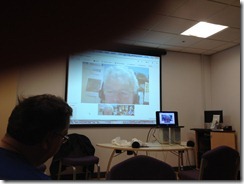
Speaking of technology's bleeding edge, Greg Stafford beamed in from California via Google Hangout. Though a bum connection introduced frustrating pauses, he revealed to Pendragon fans the deep contents of a product pipeline, including a Charlemagne campaigC-Gregn book. He explained how his recent adventures as a horseman have granted him new insight into the Arthurian cycle, and spoke of his four decades of work on Glorantha as tracing his development from youthful naivete to maturer understanding. When he got to the historicity of Arthur, Oliver Dickinson was on hand to volley back at him in tart, affectionate counterpoint.
Ooohs interspersed with aaahs at the Moon Design seminar, as co-honcho Jeff Richard showed off gorgeous art and phone book-thick manuscripts for the long-awaited Guide to Glorantha book and a Sartar-set Orlanthi campaign. The profoundest gasps were elicited by a slideshow of maps for the former, which place every detail of Greg's originals, from elevations to the nimbus of the storm god's influence, all underpinned by a five-mile hex map. This act of cartography, executed by Colin Driver, can only be described as heroic, right down to its individually placed tree symbols. The map is not only stunning as a work-in-progress, but lays the groundwork for a zoomable 3D version! Moon Design's current surge lends this starry-eyed prospect an air of downright plausibility. On a more prosaic note, Jeff laid out his move to a hybrid business model, in which the company continues to makes its nut with direct sales to the hard core, but then opens a later release window, in which Cubicle Seven pushes the books out to retail stores. We also learned which nation of Glorantha embodies the death of sixties idealism, how the current team finally nailed mysticism as a path fun player characters can follow, and the geographical parallels between the Lunar and American heartlands.

The Hillfolk game reached a groove quickly and kept on rolling. Unusually for a one-shot run, it did not evolve into a battle over the chieftainship, but instead pitted a great raider's effort to start a war with a neighboring clan against the chief counselor's scheme to ally with them against foreign enemies. Our hot-headed warrior hero faced surprise comeuppance as a disregarded female hero of the clan laid a public thrashing on him, instigated by his prospective bride, a proud champion of the rival Hard Heads.

This time around I set aside the rule that steers a one-shot run to a definitive conclusion, instead concluding by saying, “And this would be the first episode of your Hillfolk series.” Ultimately I think this is the way to go with Hillfolk demos, since it is tuned for longer-term play than many narrative-oriented games. No one seemed particularly disturbed by the open-endedness, which gives a better look at DramaSystem in the mode it's tuned for. When run at cons outside the demo context, the final escalation rules probably remain the way to go. Or maybe closure is overrated in general, and players are happy to be left envisioning more.

As always when privileged to take part in an intense moment of community, I leave Continuum exhausted and grateful. Thanks to organizer Darran Simms, games organizer Keary Birch and panel poobah Colin Driver, along with the rest of the Continuum team. Their system of just-in-time organization makes for a loose and calmly run event.
C-Dead Again

May 08, 2012

Core Resolution and Emotional Dynamics

How To Design Games the Robin Laws Way

(Part Six of Several; see part one for introduction and disclaimer)

With the core book outlined, it’s time to tackle the question of the game’s core resolution system.

(The reality isn’t so linear; thoughts about the book’s structure generally arise in parallel to ideas about the resolution system.)

If you’re designing a new game based on an existing core rules set, the choice is simple—let’s use that one. It might be dictated to you by the publisher, or a decision that you make as a designer. In the latter case, you'll obviously be constrained to the core rules sets available to you. Most likely, you’re working with a rules set by the same publisher. Or you might be using one available through a license, open or limited. We’ve already talked about the process of fitting a new game to an existing rules set; you’re presumably doing the Game X take on Y genre/setting.

If, however, I’m working from scratch, I want to design a core resolution system that creates the emotional dynamic implied by the core goal. Dying Earth, with its rolls and rerolls, evokes the comical back-and-forth of the source material. DramaSystem emulates the basic construction of dramatic scenes and otherwise gets out of the way. HeroQuest zooms out to a broader emulation of story construction, including the pass/fail cycle I later refined in Hamlet's Hit Points. GUMSHOE asks why it feels cool when heroes gather information in a mystery story, and brings that to the gaming table.

I never start out with a novel or abstractly intriguing mechanical idea and then try to build a game around that chassis. It starts with feeling. The mathematical construct is secondary; what the players are feeling when they use it is everything.

Recently I had the experience of switching from one core system owned by my publisher to the other. Before digging into the research for The Gaean Reach, I figured it would be Skulduggery-based, with bits of GUMSHOE sorted in. After reacquainting myself with Jack Vance’s delightful source material, I saw how the structure of its stories differed from the superficially similar Dying Earth tales the core rules were originally designed for. The SF novels played were more about investigation with the occasional setback than the constant picaresque reversals undergone by the likes of Cugel and Rhialto. So I shifted gears, to a GUMSHOE core with appropriate Skulduggery elements grafted on. Again this was a matter of creating the right feel, whether or not the crossover between the two systems introduces brand confusion.

February 27, 2012

Core Book Structure

Or, How To Design RPGs the Robin Laws Way (Part Five of Several; see part one for introduction and disclaimer)

Having determined the core activity and design throughline, I outline, and thus structure, the book. I ask myself first of all if either of the fundamental elements call for a nonstandard structure. If not, I start with a chapter order arising from the idea of a core activity. A roleplaying game is about the characters and what they do. Ergo, the book should start with character generation. Often this entails the provision of enough context about the setting to make decisions about the characters players are designing. So I likely kick off with a quick overview of the world, universe or what have you. The rest of the first section of the book follows the step-by-step of character generation. Into this process I try to build mirrors of the design throughline: the listed decisions, and the order in which you make them, arises from the core subject matter and emotional experience of the game. HeroQuest wants you think of your characters as part of a narrative and so (among alternate choices) asks you to start with a 100-word prose description of your character. DramaSystem focuses on drama and so asks you to first establish your role in relationship to other characters and the two opposing poles that will drive your actions. GUMSHOE privileges investigation over other activities and so presents the investigative abilities before the general ones.

Subsets of character generation then appear, from most to least important, from universal to those germane to only certain character types. Almost every designer does this, whether they articulate it this way or in some other manner they find intuitive.

After this come the core rules, which enable you to understand the stuff you've just written on your character sheet. For complex resolution systems an introductory precis may appear up top, with more detail later on, so that players understand enough to make good decisions.

After this I usually cover the setting material, because it's more fun to read, and perhaps more specific to the game, than explanatory material like GM support and play style advice. The further into a book I get, the less I expect players, rather than the GM, to grapple with its contents.

Then, if the game uses them, comes the sample adventure. Given the choice I try for as complete an example as possible. I look on the sample scenario as an extended play style example and setter of expectations. My feeling is that a truncated or perfunctory scenario that merely tries to teach you the rules is a missed opportunity at best and actively misleading at worst.

Last come the appendices, reference sheets, and other bits of useful support material that aren't part of the body of the book per se.

Whether you order things like I do or not, the careful thought you pour into this question may not matter. A certain percentage of people jump around in roleplaying games to find the bits that most interest them, and then fill in the gaps. But even as they do so, they likely notice the structure and, subliminally if nothing else, learn what you're telling them from your placement order.

February 15, 2012

In Defense of the Whiff Factor

The pacing of roleplaying sessions improves when the GM follows a simple principle: never ask for a roll if failure would lead to a dead end or other uninteresting result. This principle appears in various guises in GUMSHOE, HeroQuest, and the 4e Dungeon Master’s Guide 2.

Sometimes though, as in this recent discussion of what the DNDNext team might profitably nick from GUMSHOE, it becomes important to distinguish between an uninteresting result and a setback that makes the player unhappy.

Specifically, the so-called “whiff factor”, or prospect of rolling during combat and missing, is unrelated to the null result issue. Swinging and missing represents a loss for the player. In a mainline roleplaying game, the number of actions you can take in the course of a fight acts as an uber-resource. When you use them successfully, you whittle down your opponent’s supply of another resource, usually hit points. (Or free slots on a wound track, or whatever.) When you roll and miss an opponent, something has definitely happened—you’ve fallen behind, losing a chance to score.

Likewise, a shot on goal in a hockey game never leads to a null result. The player either scores, or has lost a chance to score, a resource the dynamic of the game works to restrict. In either case, the emotional crescendo becomes apparent in the stands. If the player scores, his team cheers. If he misses, the defending goalie’s team cheers.

Criticism may be leveled at a combat system where characters fail too often, dragging out the fight and undercutting the players’ sense of vicarious competence. But that’s a matter of striking a satisfying balance between success and failure, not of eliminating non-events.

A system may try to overcome its whiff factor by granting consolation prizes to players, in which they deal a lot of damage on a success and a smaller quantity on a failure. The question to ask here is whether that’s blunting the emotional rollercoaster of success and failure, or merely putting a new coat of paint on a skewed ratio between the two.

December 15, 2011

Core Activity and the Generic RPG

Or, How To Design RPGs the Robin Laws Way (Part 2 of several; see part one for introduction and disclaimer)

Professor Coldheart asks how the core activity comes into play in the case of a generic rules set:

How does the above mesh with designing a setting-free or generic RPG? I'm thinking of the last iteration of Heroquest, which was divorced from the Glorantha setting. Also, I presume DramaSystem might see a standalone book at some point after Hillfolk is released. It would appear that these don't have a "core activity" as you define it - or do they?

With a single notable exception, generic rules sets appear as follow-up products to existing games. Hero grew out of Champions. D20 Modern was an alternate D&D build designed in part to show the system’s flexibility. Like Chaosium’s Basic Roleplaying, they may serve as reference documents for GMs who will use them as a basis for their own games. They are a chassis on which the game is built; it remains incomplete until someone creates the core activity for it.

HeroQuest might be described as a hybrid of both models. It serves as a reference document showing you how to build your series, effectively enlisting the GM a collaborator in a simple game design process. At the same time, it’s as much a supplement to previous iterations as a new and improved version of the rules. And with its Glorantha chapter, which arose from the realization that most people buying the game would be using it in its established world, it backgrounds but still expresses the classic Hero Wars/HeroQuest 1 core activity: you play heroes fighting to shape the turning of an age in a world where myth takes on fantastic reality.

Skulduggery likewise grows out of The Dying Earth Roleplaying Game and exists as a reference document (preserving that game’s system at a time when it seemed like Pelgrane would not continue the license) and a blueprint for making your own Skulduggery mini-games. Although it has done rather better than Simon expected, it was never expected to become a flagship game the way DERPG once was, or Trail of Cthulhu has become.

Implicit in this approach is the argument that generic games are a hard sell, both to customers and to players. That’s why the first DramaSystem game will be called Hillfolk and not DramaSystem, and will present itself on the basis of the core activity. Even if we wind up including additional settings in an extended appendix. Otherwise we’re trying to get you to adopt a game that communicates on an intellectual level but lacks an emotional hook. Even the issue of visual presentation depends on a core activity, from which the graphic designer and illustrators can tweak the imagination and weave an arresting look. The rules are so short and simple that they can reappear in follow-up products without raising buyer ire.

The aforementioned exception is, of course, GURPS. It essentially marketed itself on the strength of its design throughline. It was the one game where the core activity legitimately could be “You can do anything!” Again the supplements become the games that elaborate the rules chassis into a playable experience. This was possible at the time because it addressed a gap both in the market and in the state of the art. No one had done a ground-up design meant to be generic from the jump, as opposed to the usual serial iterations of a core rules system. Having filled that gap, it removed the necessity for anyone else to attempt the same. Thus the return to the iterative model.

This has gone long, and there are still some more questions to cover. Let me know if you’d prefer that I steam ahead, or stop along the way to answer queries like this one.

December 12, 2011

Branches and Consequences

Cosmicgoose is back with another question. If I may take the liberty of paraphrasing (and I may, because this is my blog and here there is no law save for my iron will) he asks:

In Robin's Laws of Good Gamemastering, you talk about possible story branches from the characters' success and failure, and how it helps to think ahead about what these might be. In the case of failure, should you plan for characters to suffer additional negative consequences, or is the sting of losing bad enough?

Ideally, you want some but not all failures to bring about lingering negative consequences, and some but not all successes to bring positive ones. In a compelling ongoing story, those consequences arise directly from the story and make themselves self-evident. If you fail to claim the island you sailed for, you lose the queen's favor. If you succeed in capturing the magic sword, you now get to use it against your opponents.

To complicate the equation, sometimes successes ought to provoke negative side consequences, emulating the costly victory: you take the hill, but with heavy casualties. Likewise, a failure might, in a surprising twist, lead somewhere helpful. You get beaten up and captured, in the process learning something about the bad guy's plan.

Too few consequences and a session's episodes seem weightless and disconnected from one another. However, if every event brings about a lasting outcome, they will pile up and bog down the developing storyline. After a while, you and your players find it hard to come up with fresh ideas for consequences. It becomes difficult not only to bring all of them into play, but simply remember them all.

Some of my game rules tell you, as part of the resolution system, when consequences attend to an action. HeroQuest and DramaSystem both do this. During in-house testing for the latter, I had to junk any early version of the procedural system because too often led to a single result—player victory, with a negative consequence. Having fixed that, they crop up enough to add interest and weight, but not so often that the weight becomes burdensome.

December 08, 2011

The Two Fundamental Elements of RPG Design

Or, How To Design RPGs the Robin Laws Way (Part One of Several)

I've been asked to describe my process of RPG design, so let's kick off what will surely be a series of posts illuminated by your further questions. Should this need be said, this is my process and not a commandment for others to do likewise. If it sometimes seems like I'm making Olympian pronouncements it's because qualifiers are boring and I will have no truck with them.

Sometimes I pitch a game to a publisher (Feng Shui, Mutant City Blues, Ashen Stars); other times I am presented with a brief and asked to develop an approach (The Esoterrorists, Rune, HeroQuest.) The distinction between these two starting points is not always clear-cut.

The first step is to refine the initial brief, by identifying the design throughline and the core activity. Without the second, resulting game will be hard to pitch to gamers and to play. Without the first, it has little reason to exist in the first place.

The core activity I've talked about before. It tells you who the characters are and what they're doing. You're heroes fighting to shape the turning of an age in a world where myth takes on fantastic reality. You play troubleshooters for hire on a war-ravaged fringe of an interstellar empire. You lead an isolated tribe of raiders at the dawn of the iron age.

The design throughline is the central concept underlying game play, and your reason for creating a new rules set (to the extent that you are.) The game evokes the spirit of Jack Vance's stories of the Dying Earth. Or streamlines investigative play, so that the solution to mysteries depends not on finding clues but putting them together. Or provides a simple framework for the building of dramatic storylines.