 In this Gamerati interview, I talk Hillfolk, Stone Skin Press, Dreamhounds of Paris, Hamlet’s Hit Points, and our plan to apprehend Flattop, with David Melmo, the Secret DM. Check out his lovely intro, subscribe to Ed Healy’s Gamerati YouTube channel, or dive in directly below.

June 20, 2012
Video Interview with the Secret DM

June 19, 2012
New Hero Brief: Story Requirements
 With Stone Skin Press’ first books headed for pre-release roll-out, I thought you might enjoy a look inside the process, at the brief I sent out when inviting contributors to take part in The New Hero (and its later follow-up, The New Hero Volume 2). I’ll be breaking these up into blog-sized bites over the next few days. Please note that this is not a call for contributions; the books are finished and ready for the printer, the invited authors having delivered some exciting work featuring their new and newish iconic characters.
The previous installment defined the unifying structure the books revolve around. Here’s what I asked contributors to do with the theme when writing their stories.
Your story must show us everything about the hero and his environment that we need to know to understand the action. If you can imply that we’re following one of the hero’s many similar adventures, so much the better. Check out a Sherlock Holmes or Conan story to see how the classic authors of iconic serial fiction efficiently introduced their heroes and then got on with the story at hand.
Possible genres include: epic fantasy, sword and sorcery, urban fantasy, space opera, mystery, occult investigation, hard-boiled action, super heroes, pulp, special forces, espionage, gothic intrigue, steampunk, cyberpunk, and historical derring-do. This is not an exhaustive list. Surprise me. Not fitting an immediately identifiable genre is cool, too.
Likewise, feel free to set your story in the past, present or future, in this world or on an imaginary one.
We’re looking for a mix of genres so the more distinctive your choice of genre, the easier time I’ll have deciding which of the two volumes it fits in. Pick the genre you most feel at home in or that best inspire you to create a new iconic hero.
We need female as well as male heroes.
Solo protagonists are easiest to introduce and follow, but other configurations are acceptable, so long as one of them is an iconic hero. You might have your iconic hero/sidekick combo, as per Holmes and Watson, or a duality of iconic heroes, like Mulder and Scully. A team of equally iconic heroes would be hard to pull off, given space constraints, but could work.
We seek self-contained adventures featuring already iconic heroes, not origin stories in which a character undergoes a dramatic arc to become an iconic hero at the end.
We’d be happy to see further adventures of heroes you’ve featured in previous published stories. provided that they meet the iconic criteria, or can be presented as iconic heroes for the length of your story. (You might for example write a standalone adventure of a character who remains unchanged throughout but undergoes a dramatic arc elsewhere in your work.) It goes without saying that you must own the underlying rights for any existing characters (or settings) you wish to feature.
What We’re Not Looking For
As noted above, ixnay on the origin stories.
Engage the premise head-on. We’re not looking for stories that subvert, invert, deconstruct, parody, ironically riff on, or otherwise take the mickey out of the concept of the iconic hero.
Humor is okay within the context of a heroic story but we’re not looking for pieces that are predominantly spoofy.
Please don’t propose new adventures of preexisting heroes created by other authors, even if you have secured the rights to them. We are likewise not looking for new adventures of public domain heroes. Nor are we seeking Solar Pons-styles pastiches in which the names and serial numbers have been filed off of classic iconic heroes.
We’re not looking to reprint previously published stories.
June 18, 2012
New Hero Brief: What Makes an Iconic Hero?
With Stone Skin Press’ first books headed for pre-release roll-out, I thought you might enjoy a look inside the process, at the brief I sent out when inviting contributors to take part in The New Hero (and its later follow-up, The New Hero Volume 2). I’ll be breaking these up into blog-sized bites over the next few days. Please note that this is not a call for contributions; the books are finished and ready for the printer, the invited authors having delivered some exciting work featuring their new and newish iconic characters.
Unlike other anthologies united by theme or genre, The New Hero books ask writers to present material from any genre using a common structure. Here is how I presented that to the authors. Long-time readers of this blog may recognize the key concepts and examples.
The New Hero is an anthology of original fiction featuring new iconic heroes, edited by Robin D. Laws and published by Pelgrane Press.
It will consist of 14 stories, each 4500-7500 words long.
Each story features an iconic hero of the author’s creation, in any genre. The hero is presented with a problem, faces various entertaining complications as he or she engages with the problem, and solves the problem, bringing the story to a satisfying conclusion. The reader is thus left hungering for more stories starring your newly introduced iconic character.
What Makes a Hero Iconic
While a dramatic hero follows a character arc in which he is changed by his experience of the world (examples: Orpheus, King Lear, Ben Braddock), an iconic hero undertakes tasks (often serially) and changes the world, restoring order to it, by remaining true to his essential self.
Prevailing creative writing wisdom favors the changeable dramatic character over his serially unchanging iconic counterpart, but examples of the latter remain enduring tentpoles of popular culture. It’s the clear, simple, elemental iconic heroes who keep getting reinvented every generation. Each such classic character spoke to the era of its invention, while also evoking an eternal quality granting it a continuing resonance. We are going to create a new set of heroes who speak to the contemporary world while evoking the inescapable power of the iconic model.
An iconic hero re-imposes order on the world by reasserting his essential selfhood. The nature of his radical individuality can be summed up with a statement of his iconic ethos. It is the ethos that grants higher meaning to the hero’s actions, and a clue to his creator’s intentions. An iconic hero’s ethos motivates and empowers him.
-
Sherlock Holmes solves mysteries using rigorous deductive logic.
-
Miss Marple solves mysteries with a sharp mind, hidden behind a deceptively doddering demeanor.
-
Conan uses his barbaric superiority to overturn the false order of corrupt civilization.
-
Carnacki the Ghost Finder conquers fear with scientific methodology and technology.
-
Dr. Gregory House caustically tramples social decencies to solve medical mysteries, temporarily assuaging his self-loathing.
-
Batman brings justice to cowardly and superstitious wrongdoers, doing for others what he could not do for his murdered parents.
-
Storm overcomes the enemies of human- and mutantkind by wielding nature’s untamed power.
-
James Bond dispatches Britain's enemies with cold suavity and violence.
-
Tarzan upholds the noble values of the jungle against the predatory outsiders who would despoil it.
-
Philip Marlowe goes down mean streets, without himself becoming mean.
An iconic ethos implies both action and motivation. Each adventure featuring the hero is a satisfyingly ritualistic recapitulation of the character’s core action. By engaging in this recapitulation the hero restores the sense of order which was disrupted by the problem presented at the narrative’s outset.
This anthology provides your chance to create your Bond, your Batman, your Philip Marlowe.
Next: What we wanted to see in submitted stories—and what we didn’t.
June 15, 2012
The Sleeper Gene
 Remote controlled gene activation fuels a pharmaceutical conspiracy in my latest installment of StoryCraft, over at the Ancient Scroll.
June 14, 2012
June 13, 2012
The Dying Earth Revivification Folio Now Available For Pre-Order
 In Jack Vance’s stories of the Dying Earth, the sun, and thus life itself, is universally thought to be mere moments from a sad, smoldering demise. Yet inexplicably it continues to shine, allowing the world's hyper-verbal denizens to go on swindling and pettifogging one another. This is faster and more fun than ever before with the Dying Earth Revivification Folio now available for pre-order from Pelgrane Press.
My brief with this book was to create what was in effect a new edition of the game, bringing it the improvements to the basic system we built into Skulduggery, the streamlined, generic game based on the original DERPG core rules. The goal however was not to render your purchase of the original game obsolete, but to serve as a booster kit for it. It is neither game nor supplement, then, but rather a gupplement.
Wait. That’s terrible. Forget I said that.
When you think about it, really what’s happening is that DERF is now the game, and has also retroactively turned DERPG into a supplement.
Wait, never mind that either. Semantics are the cutlass of the pettifogger.
We are sometimes told that DERPG is a buyer’s favorite game he can’t get his players to try. The Revivification Folio solves that problem for you by adopting the super-fast, card-based character generation system first presented in Skulduggery. Players can jump right in without undergoing the more traditionally detailed character creation process mooted in the original book. Within minutes they are decisively ensnared.
The quick and deadly combat system is now quicker and just as unforgiving.
Magic is simplified so that the spells you wield appear on cards. In true Vancian fashion, you play the card and have used up the spell. Enchanted items can be used multiple times but are likewise presented in easy-to-use card format.
The book comes with cards to generate your first six PCs, and with notes on replacing them when they succumb to the cruelties of a decadent world.
Also included are your first three scenarios: one in which our picaresque heroes find themselves unwillingly indentured to a hotelier-slash-arch-magician, another in which they serve as guardians to a tomb-raiding expedition, and another in which they finally secure sinecures as officials in a bucolic rural village. Nothing could possibly go wrong!
June 12, 2012
Why Hillfolk Lacks Magic, Laser-Wielding Dinosaurs
Some gamers interested in DramaSystem have expressed a preference for an intial setting even more deeply geeky than a reimagined early Iron Age. Though no two ask for the same alternate setting. This excerpt from the rule book explains the choice of introductory setting.
In many classic roleplaying games, the characters become vehicles for the exploration of deep, endlessly fascinating settings. DramaSystem aims for a different sort of pleasure, one in which you leave the game remembering its people—the people you collectively created—and the things they did. To bring this experience to the forefront, it lets the background recede into, well, the background.
Hillfolk’s iron age setting is designed to appeal to at least one spectrum of geek-culture tastes, what with its swords, archaic period, imagined history, and epic clash of empires.
However, it does quite intentionally set aside a central element of popular nerdly properties. It takes place in a world without fantastical powers, whether granted by magic, futuristic technology, super mutations, or their various equivalents through other genres.
Beneath their genre-specific skinning, all of these function the same way. They’re super powers. They add flash, glamor and unique, trademarked detail to procedural stories.
By omitting the super powers, Hillfolk helps you to move faster to the heart of DramaSystem, the creation of dramatic narratives. The first time you play it, the group will, instinctively and understandably, lean toward the procedural scenes that drive other roleplaying games. Over time, as the play style manifests, procedural scenes become less frequent. Eventually you’ll start skipping over them, agreeing that certain practical outcomes have already occurred, in order to get back to the character interplay.
Having habituated yourselves to the style, you can move on to as outlandishly geeky a setting as your heart desires. Whatever flavor of super powers you choose will by that point support the game's core dynamic, instead of keeping you from it.
June 11, 2012
Tomes Fantasy Improv Show Postponed
 The fantasy/gaming-themed improv show I plugged last week has been indefinitely postponed. When organizers announce a new date I’ll let you know.
Make the Tabletop Forge Gang Think Up New Stretch Goals for their Kickstarter
 When the intrepid adventuring party behind Tabletop Forge, the app that turns Google+ Hangouts into a gaming table, announced their Kickstarter on the weekend, I figured I’d wait until weekday prime time to give their campaign a shout-out. Now I am late to the party, as they blew through their funding goal at jaw-dropping speed. Now they’re near to their stretch goal. Since further development will make this promising tool for online play an indispensable one, I say let’s test their ingenuity and see what other key inducements they come up with when they the top off that, too.
See P. XX, June Edition
 The latest edition of Pelgrane Press’ See P. XX now waves for your attention in modest yet dignified fashion. As always, it features an edition of my eponymous column, in this case devoted to the three ways in which we read RPG core books.
Alongside it in the grab bag of Pelgraney goodness: crowdfunding, Night’s Black Agents achievements and competition winners, playtest updates and opportunities, Owl Hoot Trail notes, and Simon Rogers’ latest progress report on the increasingly bustling world of Pelgrane. Check it out.
June 08, 2012
June 07, 2012
Improv Goes Fantasy – With a Hint of Hamlet’s Hit Points?
 Toronto’s coolest comedy venue is without a doubt Comedy Bar, at Bloor near Ossington. Although my favorite of the various sketch and improv formats is Catch-23, a competition in which teams have to play exactly that number of minutes worth of scenes before judge and voting audience, I may shortly have to revise that opinion, out of raw self-interest. Comic Doug Sheppard and a marauding band of fellow improvisers are unveiling Tomes, in which the group improvises based on the back cover copy of a fantasy novel they have never read. Curiouser still, Doug, who one must assume has some d20s under his furniture somewhere, got in touch to tell me that he drew some inspiration from Hamlet's Hit Points. I’ll be checking out the epic first performance on June 20th at 8 PM and reporting back afterwards. Keep up with Tomes events by liking their Facebook page.
Update: This event has been indefinitely postponed. When I get word of a rescheduling, I’ll let you know.
June 06, 2012
Atomic Overmind Announces New Tales of the Yellow Sign Print Edition
You asked for it, you got it. New Tales of the Yellow Sign, my upcoming collection of short stories inspired by the classic weird tales of Robert W. Chambers, will be available not only in ebook format, but in a print edition from Atomic Overmind Press. I’m happy to 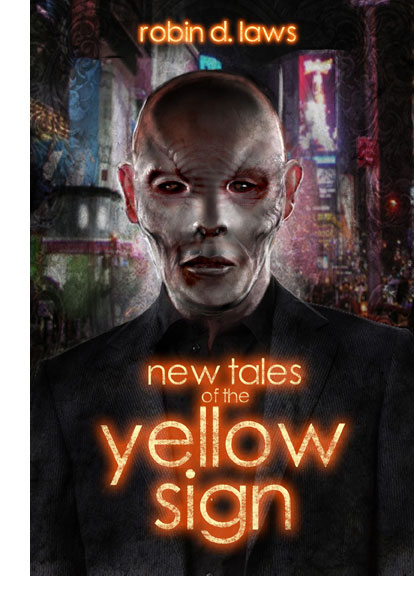 be able to accommodate the reading and collecting habits of the bibliomanes among you, and proud to be part of a line including Kenneth Hite’s Tour de Lovecraft and Cthulhu 101. Adding to the bragging rights, New Tales represents Atomic Overminder Hal Mangold’s first foray into straight-up fiction.
The print edition is scheduled for a September 2012 release, but we’ll sneak some advance copies to Gen Con, allowing attendees there the first shot at forever blasting their fragile mental conditions.
Once we go from cover mock-up (seen here) to finished cover, I’ll get the wheels in motion on ebook distribution. This is my first adventure in that format, and I’ll keep you updated as the electronic version wends its way to market.
Here’s the announcement text, as also found on the Atomic Overmind site.
In the dying years of the 19th century, a book changed the world—or worlds. A slim, sinister text called The King in Yellow drove those who read it to madness. Despite suppression by anxious authorities, it spread through global culture, and history itself, like a virus. Now the contagion bears hideous fruit.
Disturbing, dissonant and riddled with negative capability.
- Simon Rogers, Pelgrane Press
New Tales of the Yellow Sign expands the classic horror mythos of weird tales pioneer and Lovecraft precursor Robert W. Chambers into new vistas of unease and imagination. Over the course of eight troubling stories, writer and visionary game designer Robin D. Laws lures you into diseased timelines, impossible pasts, and the all-too-terrifying present.
Poison and beauty lie before you, in any color you want.
– Kenneth Hite, author, Tour de Lovecraft: The Tales
Sterilize your suicide chamber, harken to the remorseless clicking of your black box, and whistle for the monstrous creature that lives in your basement. The pallid mask awaits.
All of these New Tales of the Yellow Sign orbit lost Carcosa, black star points poked through the white scrim of consensus reality by the force of Chambers’ book. But each swings past on its own trajectory, a mix of styles and concerns in counterpoint to Chambers’ unified “Gallic studio atmosphere” of the Yellow Decade. Each story launches itself in fugue from one (or more) of Chambers’ originals, passages that Laws plays adagio or largo on different instruments, plays for modern dancers and not Victorian wallflowers.
– Kenneth Hite, from his Foreword
New Tales of the Yellow Sign is a 170-page trade paperback from Atomic Overmind Press, acclaimed publishers of Tour de Lovecraft: The Tales, and Cthulhu 101.It will release in September of 2012, with a preview release at the Gen Con Indy 2012.
The novels of author and game designer Robin D. Laws include Pierced Heart, The Rough and the Smooth, and The Worldwound Gambit. Robin created the GUMSHOE investigative roleplaying rules system and such games as Feng Shui, The Dying Earth, The Esoterrorists and Ashen Stars.
Atomic Overmind Press is an Alexandria, Virginia-based publishing house, founded in 2008. The Overmind and his creative partners are dedicated to bringing the best in esoteric science-fiction, fantasy, horror, fringe culture, and hobby gaming to a global audience.
June 05, 2012
90% Vampires
 As someone who has himself been guilty of diagramming out narrative structures, I recently had my attention directed to an infographic alleged to depict the thematic content of a particular book. On first glance, this looks cool, and not unlike the slow downward progress of a Hamlet’s Hit Points beat analysis map.
When you check out what it actually measures, the wonkiness surfaces. Welcome to the blissfully obtuse world of the Book Genome Project, which measures the quantity of certain tropes and motifs, which it seems to think are the same thing as themes. It bases itself on the already peculiar assumptions of the Music Genome Project, which powers the Pandora streaming service. The MGP thinks that people choose music based on abstract, objective criteria like “major key tonality” or a “dynamic male vocalist.” Actually we respond more according to cultural aspiration, identity formation, and the indefinable talent of people working within the styles we’re already drawn to. When Pandora works, it’s because of its user fine-tuning.
Gene-sequenced music seems downright on-point compared to judging a book by the quantity of attention given to a motif or trope in a work of literature. This leads to such hilarity as the following gem, from the Book Lamp FAQ. (BISAC is the standard subject header system, as seen on a book’s front matter page.)
A book with 90% Vampires is a very different book than one with 5% Vampires, but both would probably receive the same label in the BISAC classification.
Clearly the above was typed by an android.
We as readers might respond to certain tropes and motifs, seeking some and staying clear of others. But they are externals, and tell us nothing about why one story using a motif becomes a staple of the canon and countless others vanish from the collective imagination.
Believe me, I didn't want to take the glasses off for this one. But if we’ve learned nothing else here today, vampires are not a theme!
June 04, 2012
With New Hero 2 Cover, Gene Ha Out-Awesomes Himself
For the fiction writer, the process of having one’s work illustrated serves up anxiety by the bucket load. You are not only at at a remove from the art direction process, but often out of the loop altogether. Instances of character images being shaped more by inattentive illustrators than the text abound in genre literature. And that’s for novels. The idea that you’d have significant input into a short story cover lies beyond the silver veil of authorial dreams.
That an artist would take it on himself to communicate with the writers of a short story collection, taking heed of their input and making adjustments accordingly—why, that’s got to be a crazy myth, on the order of the unicorn. That the artist would then labor to include every single lead character in a collection of fourteen—often with sidekick? Why, that’s a chocolate unicorn riding a platinum unicorn atop a prompt cable installer.
Unless we’re talking Gene Ha, in which case it is just Gene being Gene. Here’s his cover for Stone Skin Press’ The New Hero 2.

As part of our deal when I agreed to sign on as Stone Skin’s Creative Director, Simon Rogers required that I occasionally include my own stories in these anthologies, no matter how unCanadian that might make me feel. The yellow dude with the German shepherd is Longthought, my mutant hero of the semiotic apocalypse, from the story “Among the Montags.”
June 01, 2012
The Lion and the Aardvark cover reveal
As previously touted hereabouts, Pelgrane Press is launching a fiction imprint, Stone Skin Press, with yours truly serving as Creative Director. The fourth book in our series of genre-busting anthologies will be The Lion and the Aardvark, a collection of modern fables from an impressive talent roster from writing scenes near and far.
Today we unveiled a cover mock-up to highlight the splendid illustration by Jim Zub, of Skullkickers and Udon fame. It brings a 1900s editorial cartoon style to the dueling laptops wielded by the opposed protagonists of Ekaterina Sedia’s title story.
I’m sure you’ll agree that Jim’s work more than meets the gold standard already set by Stone Skin cover artists, Gene Ha and Jason Morningstar.
We’re slating this for a Christmas release, so save space in your stockings.

The Ancient Scroll Presents Storycraft
Today The Ancient Scroll, a site specializing in RPG story ideas, launches the inaugural edition of StoryCraft, a column of scenario outlines written by well-known game designers. They’ve engaged me to write an installment every two weeks. Subscribe to their RSS feed, or keep an eye out for my links here on the blog or from whichever social media platform you use to track my doings.
The first installment, “By Fate Enslaved”, keys off an intriguing passage in Edward Gibbons’ Decline and Fall of the Roman Empire to present a tale of sudden slavery, a decadent imperial metropolis, and daring rescue. Check it out... in the original English, or in Polish translation.
May 31, 2012
May 30, 2012
Shortlist For 2012 Diana Jones Award Announced
RPGs, LARPs, a board-game and crowdsourced funding vie for hobby-gaming’s most eclectic and exclusive trophy.
The committee of the Diana Jones Award has announced the shortlist for its 2012 award. The list contains five candidates that in the opinion of the committee exemplify the very best that hobby-gaming produced in 2011. In alphabetical order, they are:
BURNING WHEEL GOLD, an RPG system by Luke Crane, published by Burning Wheel.
CROWDFUNDING, with particular acknowledgment to Kickstarter.
NORDIC LARP, a book by Jaakko Stenros and Markus Montola, published by Fëa Livia.
RISK LEGACY, a board game by Rob Daviau, published by Hasbro Inc.
VORNHEIM, an RPG supplement by Zak S, published by Lamentations of the Flame Princess.
The winner of the 2012 Award will be announced on Wednesday 15th August, at the annual Diana Jones Award and Freelancer Party in Indianapolis, the unofficial start of the Gen Con Indy convention.
ABOUT THE AWARD
The Diana Jones Award for Excellence in Gaming was founded and first awarded in 2001. It is presented annually to the person, product, company, event or any other thing that has, in the opinion of its mostly anonymous committee of games industry luminaries, best demonstrated the quality of excellence in the world of hobby-gaming in the previous year. The winner of the Award receives the Diana Jones trophy.
The short-list and eventual winner are chosen by the Diana Jones Committee, a mostly anonymous group of games-industry alumni and illuminati, known to include designers, publishers, cartoonists, and those content to rest on their laurels.
Past winners include industry figures such as Peter Adkison and Jordan Weisman, the role-playing games Nobilis, Sorcerer, and My Life with Master, the board-games Dominion and Ticket to Ride, the website BoardGameGeek; and the charity fundraising work of Irish games conventions. Last year’s winner was Fiasco by Jason Morningstar. This is the twelfth year of the Award.
More information is available at www.dianajonesaward.org or at the Award’s Wikipedia page at http://en.wikipedia.org/wiki/Diana_Jones_Award.
CONTACT
For more information or an invitation to the announcement of the 2012 Diana Jones Award you can contact a representative of the DJA committee: committee@dianajonesaward.org
May 29, 2012
The Warehouse of Dorian Gray
 Insurers specializing in high-end art have become increasingly worried by the proportion of their clients’ art collections stored in a small handful of warehouses, mostly in Switzerland. By stashing their art at a so-called free port, the hyper-rich avoid taxes and customs fees.
To rip this story from the headlines, we can see an obvious plot for a heist flick, in which the PCs plot a single score allowing them to scoop up enough masterpieces to stock a world-class museum.
Let’s bend it a little into a premise for a Night’s Black Agents scenario. A venerable vampire, who perhaps once shared absinthe with Oscar Wilde, has transmitted his soul essence into a painting. You know the drill—it ages, he doesn’t. The only way to destroy him is to burn the canvas. He’s stashed it in a free port, confident that its experts will give it all the security they’d provide to a Rembrandt or Picasso.
The mission: under the guise of an ordinary heist, get in there and grab the painting—either to end him, or gain leverage to squeeze favors out of him, in furtherance of your broader war against the international bloodsucker hegemony.
Subscribe to:
Posts (Atom)